
7 Signs Your Parent May Need Assisted Living
Most families don't wake up one day and decide it's time for assisted living. It builds slowly — a fall here, a missed pill there, a fridge that's a little emptier than it used to be. By the time it feels urgent, the signs have usually been there for months.
This guide walks through seven signs worth paying attention to, what each one might mean, and what to do before a crisis makes the decision for you.
Quick Answer
A parent may need assisted living when daily life at home is no longer safe or sustainable without regular support — help with medications, meals, bathing, mobility, or safety checks — but full nursing or a secured memory care setting isn't yet needed. The real question isn't "can they still live at home," it's "can they live at home safely, consistently, and without wearing the family out."
1. Falls or Near Falls Are Increasing
Falls are one of the clearest red flags. One fall doesn't automatically mean it's time — but repeated falls, close calls, or a growing fear of falling deserve a real conversation.
Watch for unexplained bruises, furniture being used to walk from room to room, avoiding the stairs, trouble getting up from a chair, or a sudden reluctance to shower alone.
Plain-English answer: If falls are becoming more frequent or your parent is visibly avoiding movement out of fear, assisted living can offer safer routines and faster response when help is needed.
2. Medications Are Being Missed, Doubled, or Confused
Medication mix-ups are one of the most common things families notice first — pills still sitting in the organizer, prescriptions that expired months ago, or a dose taken twice because the first one was forgotten.
Plain-English answer: If your parent can't reliably manage medications without daily check-ins from family, structured medication management is one of the fastest wins assisted living provides.
3. Meals and Nutrition Are Slipping
The refrigerator often tells the real story — expired food, weight loss, meals replaced by crackers or snacks, or simply less interest in eating alone. Sometimes it's physical, sometimes it's memory, sometimes it's depression. Either way, it usually means the daily structure around meals has broken down.
Plain-English answer: If your parent isn't eating regularly or preparing meals safely anymore, assisted living provides consistent meals and daily observation without you having to manage it long-distance.
4. Bathing, Dressing, or Hygiene Are Becoming Difficult
This one is easy to miss because parents often hide it out of pride. Signs include the same outfit worn repeatedly, laundry piling up, or a growing fear of the shower — which makes sense, since bathrooms are one of the most dangerous rooms in a home for an older adult managing balance and slippery surfaces.
Plain-English answer: If hygiene is slipping or bathing has become unsafe, assisted living offers respectful, private support that protects both safety and dignity.
5. The Home Itself Is Becoming Hard to Manage
A parent can love their home and still not be safe running it alone anymore — unopened mail, unpaid bills, poor lighting, cluttered walkways, or a stove left on are all signs the house has become part of the risk rather than a safe base.
Plain-English answer: If the home is becoming a hazard rather than a comfort, assisted living removes the burden of managing a house while reducing daily risk.
6. Isolation or Loss of Routine Is Increasing
Physical safety isn't the whole picture. A parent can be technically safe at home and still be declining emotionally — withdrawing from friends, skipping activities they used to enjoy, sleeping most of the day, or going long stretches without real conversation.
Plain-English answer: If isolation is setting in, assisted living offers something home can't always provide: a built-in daily rhythm of meals, people, and activity.
7. Family Caregiving Is No Longer Sustainable
This is often the hardest sign to admit. Caregiving has a way of quietly becoming a full-time job — missed work, constant worry, disrupted sleep, tension between siblings, or a nagging sense that the whole plan depends on one exhausted person.
Plain-English answer: If the caregiving plan only works because someone is burning out, it isn't really working. Assisted living can protect both your parent and the family member holding it together.
When Assisted Living May Not Be Enough
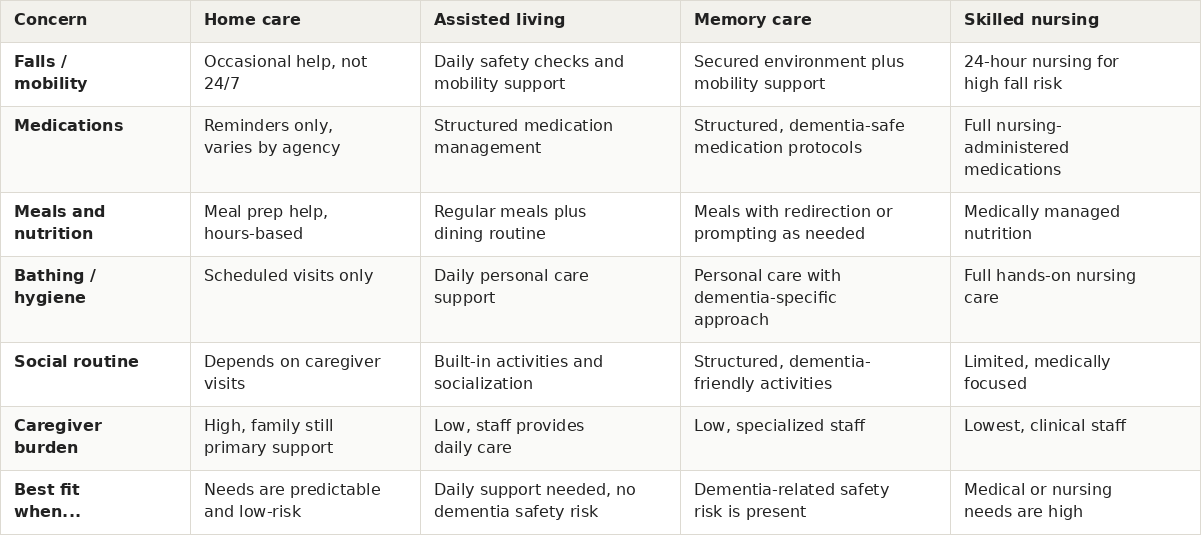
Assisted living is built around daily support — not dementia-related safety risks or heavy medical needs. If wandering, exit-seeking, sundowning, or unsafe judgment are part of the picture, memory care is usually the better fit. If the need is complex wound care, major post-hospital weakness, or round-the-clock nursing, skilled nursing or rehab is likely the right next step instead.
Which Level of Care Fits? A Side-by-Side Comparison
What Assisted Living Provides in Illinois
In Illinois, assisted living generally means a residential setting that combines housing with personal, supportive, and intermittent health-related services, available as needed around the clock. That typically covers help with eating, dressing, bathing, transferring, and personal hygiene — support with daily life, not hospital-level medical care.
Before You Tour, Write Down:
Your top three safety concerns, fall history, medication issues, hygiene or bathing needs, mobility level, memory concerns, current support in place, budget range, and preferred towns or distance from family. Touring with this list means you're evaluating fit, not just the lobby.
If You're Near Geneva, St. Charles, Batavia, North Aurora, or Aurora
If you're seeing these signs and aren't sure what the right next step is, that's exactly where a second opinion helps. Families across Geneva, St. Charles, Batavia, North Aurora, Aurora, Elgin, South Elgin, and the wider Fox Valley area often aren't sure whether home care, assisted living, or memory care fits best — and the goal isn't to push you toward a decision, it's to help you see the situation clearly.
Since founding Senior Source, I've personally guided more than 40 Fox Valley families through evaluating memory care, assisted living, and senior care options — with the kind of one-on-one attention a national call center can't offer.
Brad Esposito – Senior Source Phone: 630-835-0355 Website: ILSeniorSource.com
FAQ
What are the signs my parent needs assisted living? Common signs include falls, medication mistakes, skipped meals, poor hygiene, unsafe home conditions, isolation, and family caregiver burnout.
Does one fall mean my parent needs assisted living? Not always. One fall should prompt a safety review. Repeated falls, fear of falling, or trouble transferring may mean more daily support is needed.
When is home care enough instead of assisted living? Home care may be enough when needs are predictable, safety risks are low, your parent accepts help, and family can still monitor the situation.
When is memory care needed instead of assisted living? Memory care may be needed when dementia creates safety risks such as wandering, exit-seeking, sundowning, paranoia, medication misuse, or the need for frequent supervision.
What should families do before touring assisted living? Write down the top care needs, safety concerns, fall history, medication issues, hygiene needs, memory concerns, budget range, and preferred location.
Can assisted living help with medications and bathing? Many assisted living communities can help with medication management, bathing, dressing, meals, routine, and safety checks, but services and pricing vary by community.
Who can help us decide if assisted living is the right step? A physician, care manager, home care agency, senior living advisor, hospital discharge planner, or assessment nurse may help depending on the situation. Senior Source helps families compare local options and understand the next step.


