
MEMORY CARE PLACEMENT QUESTIONS, ANSWERED
Memory Care Placement
Real answers about when memory care becomes necessary, what it includes, and how to know if it's the right fit for a parent with dementia or memory loss in St. Charles, Geneva, and the western suburbs.
What Memory Care Actually Includes
Memory care is a specialized form of senior living designed for people with Alzheimer's disease or other dementia, offering secured environments, structured routines, and staff trained specifically in dementia care. It goes beyond standard assisted living by addressing safety risks like wandering, exit-seeking, and sundowning that a general community may not be equipped to manage.
Families throughout St. Charles, Geneva, Batavia, and the greater Tri-Cities area often reach out after noticing new confusion, unsafe behavior, or a diagnosis that's changing what daily life looks like at home. The questions below reflect what we hear most often from local families trying to figure out whether it's time for memory care—or whether assisted living can still meet their loved one's needs.
"A diagnosis alone doesn't mean it's time for memory care. It's about whether the home is still safe—and whether that's still true six months from now." — Brad Esposito
Secured, dementia-trained environment
24-hour supervision and structured daily routines
Support for wandering, exit-seeking, and sundowning behaviors
Medication management for dementia-related conditions
Specialized activities designed for cognitive engagement
Higher staff-to-resident ratios than standard assisted living
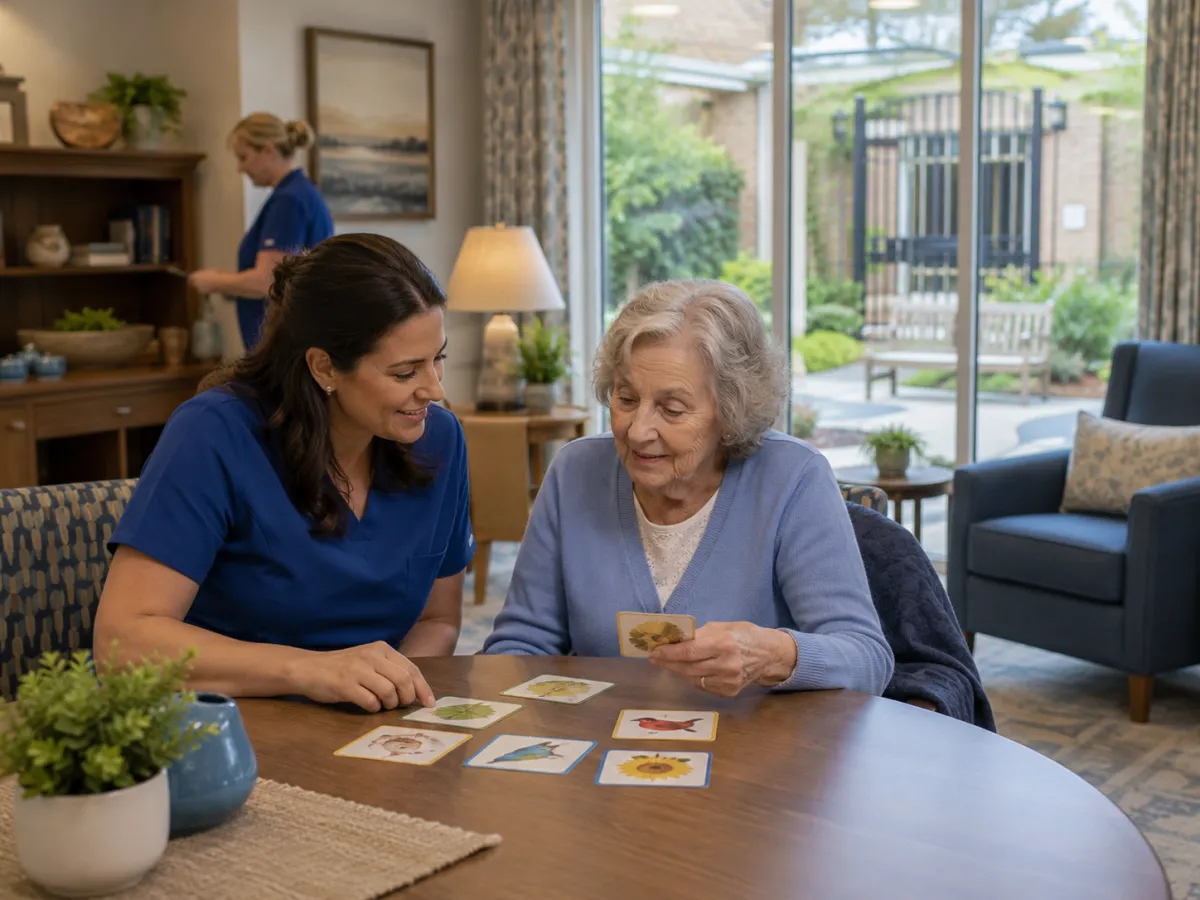
What to know about Memory Care
When is it time to consider memory care?
Memory care should be considered when dementia-related safety and supervision needs are becoming too difficult to manage in the current setting.
Common signs include:
Wandering or exit-seeking
Getting lost
Unsafe cooking
Repeated medication errors
Nighttime confusion
Paranoia or agitation
Entering other people’s rooms
Inability to call for help
Caregiver exhaustion
Frequent attempts to leave home
Refusing important care
Memory care is not simply assisted living behind a locked door. Families should evaluate staffing, training, activities, behavior support, communication, and how the community responds when someone is frightened or confused.
Does wandering automatically mean someone needs memory care?
Not automatically, but wandering is a serious safety concern.
The family should understand what “wandering” actually means.
Is the person pacing inside the home? Walking outside with purpose? Leaving at night? Getting lost? Trying to return to a former home? Entering unsafe areas?
The frequency, timing, environment, and ability to redirect the person all matter.
When someone can leave unnoticed, cannot find their way back, or does not recognize danger, a secured memory care setting may need to be considered
What is sundowning in dementia?
Sundowning describes increased confusion, restlessness, anxiety, agitation, or disorientation that happens later in the afternoon or evening.
A person may begin pacing, repeatedly asking to go home, trying to leave, becoming suspicious, seeing or hearing things that are not there, or having difficulty sleeping. Sundowning is not a separate disease. It is a pattern of symptoms that can occur with Alzheimer’s disease and other forms of dementia.
Families should also avoid assuming that every evening behavior is simply “the dementia.” Pain, infection, dehydration, medication side effects, poor sleep, hunger, or overstimulation may make the behavior worse.
A consistent routine, good daytime activity, appropriate lighting, reduced evening noise, and avoiding long late-day naps may help. A sudden or significant change should be discussed with the person’s healthcare provider.
Can memory care help with paranoia, agitation, or repeated attempts to leave?
Yes, an appropriate memory care community may be better equipped to manage these behaviors through increased supervision, a secure environment, predictable routines, trained staff, reassurance, redirection, and activities designed for people living with dementia.
The goal should not be to argue with the resident or repeatedly prove that the person is wrong. Staff should try to understand what the behavior may be communicating.
Someone attempting to leave may believe they need to go to work, pick up a child, return to a former home, or find a spouse. Paranoia or agitation may be connected to fear, confusion, pain, unfamiliar surroundings, or an unmet need.
Memory care cannot guarantee that every behavior will stop. Families should ask how the community handles exit-seeking, aggression, accusations, hallucinations, and difficult evenings—and what would cause the community to say it can no longer safely provide care.
New or suddenly worsening behavior should also receive medical attention because infection, pain, medication changes, and other health problems can contribute to agitation or confusion.
What does a secured memory care community mean?
A secured memory care community uses controlled entrances and exits to reduce the risk of a resident leaving unnoticed and becoming lost or injured.
That does not mean residents are locked in their bedrooms. Residents should generally be able to move throughout the secured living area and may have access to enclosed outdoor courtyards, walking paths, common rooms, dining areas, and activity spaces.
The security system may include controlled doors, alarms, delayed-egress systems, staff monitoring, or other safeguards. Memory care communities are intended to provide increased supervision and a safer environment for people who may wander or become confused about where they are.
Families should ask:
Which doors are secured?
Can residents safely walk outside?
Who responds when an exit alarm sounds?
How are visitors admitted?
How are residents evacuated during an emergency?
What happens when someone repeatedly tries to leave?
The word secured tells you something about the environment. It does not, by itself, tell you whether the staffing or care is strong.
How is memory care different from a locked nursing home unit?
Memory care and a nursing home dementia unit may both provide a secured environment, but they usually provide different levels of medical and nursing support.
Memory care located within an assisted living community generally focuses on personal care, supervision, medication assistance, meals, structured routines, activities, and dementia support.
A nursing home dementia unit is designed for residents who may also need a higher level of ongoing nursing or medical care. Nursing homes and assisted living establishments are licensed and regulated as different types of care settings in Illinois.
The name of the unit is less important than what it can actually provide. Ask:
Under what type of Illinois license does the community operate?
Is a nurse physically present around the clock?
Can the community manage complex wounds or significant medical needs?
Can it provide mechanical-lift or extensive transfer assistance?
What needs would require a move to skilled nursing?
A secured door does not automatically mean the building offers nursing-home-level care.
What training should memory care staff receive?
Memory care staff should receive dementia-specific training—not only general caregiver orientation.
Training should cover:
How dementia affects memory, judgment, communication, and behavior
Person-centered communication
Redirection and de-escalation
Wandering and exit-seeking
Agitation, paranoia, hallucinations, and sundowning
Bathing, dressing, toileting, and eating challenges
Recognizing pain, infection, delirium, and changes in condition
Fall prevention and emergency response
Supporting residents without unnecessarily arguing, restraining, or frightening them
Communicating with families
Illinois requires staff with direct access to people living with dementia to receive initial and ongoing dementia training. State rules also establish additional qualifications and continuing-education requirements for the person supervising Alzheimer’s and dementia services.
Families should ask more than, “Are your employees trained?”
Ask:
“How much dementia training do new employees receive, who provides it, how often is it renewed, and how do supervisors know the training is being used on the floor?”
The minimum requirement and the daily culture of the community are not always the same thing.
How do memory care communities handle residents who refuse bathing or medications?
A strong memory care team should first try to understand why the person is refusing.
Bathing may feel frightening, cold, embarrassing, rushed, or physically painful. The resident may not recognize the caregiver or understand why someone is asking them to remove their clothes.
Staff may try a different time of day, a familiar caregiver, a caregiver of the same sex, simpler instructions, more privacy, a towel bath, music, or allowing the resident to complete as much of the task independently as possible.
Medication refusal should be taken seriously. Staff should document what happened, try appropriate redirection, notify the nurse, and involve the prescribing provider and family when the refusal may affect the resident’s safety or health.
Families should ask:
How long will staff continue trying?
Will another employee approach later?
When is the nurse notified?
When is the family contacted?
What happens when an essential medication is repeatedly refused?
How is the care plan changed?
The answer should not simply be, “We make them take it.” Dementia care requires patience, investigation, and an individualized approach.
Can couples stay together when only one spouse needs memory care?
Sometimes, but the options vary by community.
Some campuses allow both spouses to live in memory care. Others may offer a companion suite, place one spouse in assisted living near the memory care neighborhood, or allow the spouse without dementia to spend much of the day with their partner.
The decision depends on apartment availability, cost, the needs of both spouses, and whether living inside memory care would be comfortable and appropriate for the spouse who does not need that level of support.
Ask:
Can both spouses live in the same apartment?
Must both spouses pay memory care pricing?
Can the healthier spouse come and go independently?
Could they live in separate apartments on the same campus?
What happens if the healthier spouse later needs care?
How frequently can the couple spend time together?
Staying under one roof is emotionally important, but it is not the only measure of staying connected. In some situations, nearby apartments with daily visits, meals, and activities together may work better than placing both spouses in the same level of care.
How do I move a parent with dementia who does not understand why they need to move?
Do not expect one perfect explanation to make the move understandable.
A person living with dementia may not remember the falls, medication errors, wandering, or other events that led to the decision. Repeatedly reviewing those failures may create fear or anger without creating understanding.
Keep the explanation short, calm, and consistent. Focus on what is happening next rather than trying to win an argument.
You might say:
“We are going to a place where you can get some extra help while we make sure everything is okay.”
Work with the community before move-in. Share your parent’s routines, career, family history, food preferences, sleep habits, fears, favorite music, and the words that tend to calm them.
Whenever possible:
Move familiar furniture and photographs into the room first.
Choose the time of day when your parent is usually at their best.
Avoid a large group of family members debating the move in front of them.
Keep moving day organized and relatively quiet.
Ask a familiar staff member to greet and engage them upon arrival.
Give the community time to begin establishing a routine.
Moving is a major adjustment for both the person living with dementia and the family. Getting to know the staff and planning the transition in advance can make it less disruptive.
When decision-making authority is unclear or family members disagree, involve the physician and an elder law attorney before the crisis becomes more urgent.
What should families look for when touring memory care?
Look past the furniture, finishes, and model apartment.
The most important question is not whether the memory care neighborhood looks beautiful. It is whether the staff can understand, engage, redirect, and safely care for your family member.
Pay attention to:
How staff speak to residents
Whether residents appear engaged or are sitting without interaction
Noise, lighting, cleanliness, and overall calmness
Whether staff know residents by name
Access to safe outdoor space
Staffing during evenings, nights, and weekends
How frequently residents receive meaningful activities
Whether activities match different stages of dementia
How the community handles wandering and exit-seeking
How bathing and medication refusals are managed
How falls and sudden behavior changes are addressed
How families receive updates
What care needs or behaviors could lead to discharge
What additional care charges may be added later
Ask to meet the memory care director or nurse—not only the salesperson.
When touring memory care in Geneva, St. Charles, Batavia, Aurora, Elgin, Naperville, or another nearby city, also ask how long the department leaders have been there and how much turnover the direct-care team has experienced.
Quality dementia care should be person-centered, based on an individualized care plan, and supported by staff who understand the resident’s preferences, abilities, history, and changing needs.
Can someone be too medically complex for memory care?
Yes. A person may need more medical or nursing support than an assisted living memory care community can safely provide.
The answer depends on the community’s license, nursing coverage, staffing, equipment, and care policies.
Concerns may include:
Complex or unstable medical conditions
Significant wound care
Frequent skilled nursing needs
Feeding tubes or certain IV treatments
Extensive transfer assistance
Mechanical-lift needs the community cannot support
Inability to safely evacuate
Repeated medical emergencies
Behaviors that place the resident or others at serious risk
A need for continuous clinical monitoring
Some memory care communities can support residents with wheelchairs, incontinence, hospice, diabetes, or significant physical assistance. Others have much narrower care limits.
Illinois assisted living and nursing facilities operate under different regulations and are designed to provide different levels of care.
Before paying a deposit, give the community a complete and honest description of what happens on the resident’s most difficult day.
Ask:
“What exact medical, mobility, or behavioral change would make you unable to continue caring for my parent?”
That answer may be more important than whether the community can accept the person today.


quicklinks
Get in touch
Senior Source - Senior Living Advisors
200 W River Dr
St. Charles IL 60174
630-835-0355
Monday-Friday: 8am-4:00pm
Weekends by Appointment
Subscribe to our Newsletter
Learn more about what's happening in our local area. Events, Activities, and Resources
© 2026 Senior Source LLC Copyright. All rights reserved